So Who Invented the Cell Phone Again?

CNET has gone on a spelunking expedition into the recent AT&T FCC filing and brought a few things up to the surface. One nugget that caught my attention is from a document written by AT&T’s Chief Technology Officer, John Donovan.

Donovan says AT&T “invented the first mobile phone and the first mobile network”.

Wait, wasn’t there another company involved? It will come back to me.Continue reading

Group Conferencing Startups: Pay the USF Fees

It’s a slow afternoon here, so I had a little time  to consider one mind-numbing regulatory aspect of the growing number of group messaging and conferencing startups.

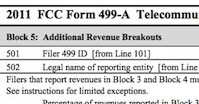
Eventually when these companies (Fast Society, Group.me, et. al) start charging for their services—most of them don’t now—my understanding is that they will be required to file an FCC Form 499.

Ok, so it was a very slow day.

Remember Form 499? That’s where providers of telecommunications for pay—and that includes call conferencing services—tell the FCC about their VoIP revenues apportioned to interstate connections.

And then our regulators calculate how much money is owed to the Universal Service Fund kitty.Continue reading

Radiolab’s "Good" Explains Social Networking

If you’ve not ever heard of political scientist Robert Axelrod and his computer modeling of altruism in the early 1980s, immediately go and listen to the podcast of a RadioLab show—public radio’s best hour— entitled “Good.”

Do that now.

Skip to around the 41 minute mark, and you’ll hear the start of Jad and Robert chatting with Axelrod. Aside: Often when I read something interesting, I imagine it spoken in a Robert Krulwich voice to decide if it would make a worthy post.

Anyway, “Good” is the best popular introduction I’ve come across as to why we’ve evolved to be civil to others.Continue reading

Cisco’s ‘Epic’ CRS-3 is One Year Old

How could I have missed that birthday? I’ll have to send the CRS-3 a belated card.

You may recall that Cisco raised expectations just a little a year ago when it proclaimed that it would reveal a product that would change the Internet forever.

My sources tell me that Internet has said it doesn’t feel too much different.

Continue reading

Royal Wedding on YouTube

Reuters reports that the Royal Wedding, scheduled for April 29, will be live streamed on YouTube over the The Royal Channel.

Remote commoners will be able to watch and even interact with all the pomp and ceremony.Continue reading

NYC Startup Weekend Finale: 2 Hours, 20+ Presentations

Did I really hear 20 or so presentations in a little over 2 hours at the conclusion of NYC Startup Weekend?

According to my barely legible notes, scribbled while standing up in the very crowded kitchen area in General Assembly’s co-working space, I had a few insightful comments on each one of them.

My quick, emotional assessments differed from the judges: I didn’t quite ‘get’ PlayMob, the first place winner; dismissed too quickly the second place winner, WeTrip.it, the on-line group vacation piggy bank, and perhaps let my group conference calling prejudices get in the way of appreciating third-place Bridg.me.

No matter, I was impressed with many of the pitches, amazed at what Red-Bull fueled developers could accomplish in 48 hours, and learned that even cold NYC falafels still taste really good.Continue reading


NYC Data Coven

They gather at their East Village temple to listen to their leaders chant arcane codes involving greek letters as they attempt to divine the future.

I am of course referring to the NYC Predictive Analytics  monthly meetup held at the 6th floor of 770 Broadway, AOL headquarters.

I stopped by last night to see if I could learn how to create my own digital crystal ball. Continue reading

NYU Startup Week Starts Up

I launched my own StartUp Week festivities by attending last night’s Entrepreneur Panel at NYU’s Kaufman Auditorium, a place I’ve become quite familiar with lately.

Having reached saturation on pure software startups, I decided to take in the Biotech-Cleantech-Social panel that was scheduled for the second half.

I wanted to hear, for a change, about entrepreneurs who made or had more intimate connection with actual physical stuff, in this case drug molecules, smart thermostats, and software that maps and  helps preserve flora and fauna, the organic stuff of the world.Continue reading

Google on USF Reform: Bill and Keep

Maybe it’s the result of a second espresso I had this morning, but Google’s recent comment on the FCC’s Notice of Proposed Rule Making on Universal Service Fund reform doesn’t read like a typical carrier screed.

It’s their engineering culture. They won me over a little when they said that “IP transmission, in itself, is not ‘magic pixie dust’ that somehow creates a regulation-free zone.”Continue reading

Back at the FCC: Pole Rules are Streamlined

Sometimes grand visions, say the FCC’s National Broadband Plan, can depend on something as basic and overlooked by the lay person as a utility pole.

Think about it: to wire up the country with high-speed fiber, carriers need quick access to utility poles.

The Communications Act as amended in 1996 weighs in on this matter, calling for “nondiscriminatory access to any pole, duct, conduit, or right-of-way owned or controlled by it.”

Think of it as net neutrality for wiring.Continue reading

Readability: Micro-pay the Writer

I missed yesterday’s New York Tech Meetup. I’ll be fine.

However, I would have liked to have seen the Readability demo and learned more about this company’s plans.

Their FireFox plug-in de-clutters a typical web page, removing graphics, Flash, and other visual ephemera leaving you with just the nutritious text.

The software was reviewed by David Pogue in November 2009.  And it ended that year with a coveted Pogie Award.

Since the Pogie, Readability added some new features to boost the original text-centric idea. And then in a move that as far as I’m concerned nailed their dedication to the written word, they’ve installed a micro-payment system for authors. Continue reading

NYC Next Idea

The New York City Economic Development Corporation is an agency tasked, not surprisingly, with stimulating the local economy. This includes our booming information economy, and in fact NYCEDC are the folks behind the BigApps competition.

Final presentations for another idea of theirs called, naturally, NYC Next Idea, were held this morning at Columbia University’s Shapiro Center. The six startups that made their presentations to the judges—as assortment of entrepreneurs, investors, and Steven Strauss, an NYCEDC director— had been winnowed from over 150 worldwide entries.

The common theme among this group of  university student finalists was their desire to set up shop in NYC.Continue reading