

You will be your first investor.  This is not: you should be your first investor,  you might be your first investor,  it would be nice …

Hoboken Tech Meetup 2/23/11: David S. Rose’s Reality

Hearing angel investor David S. Rose (@davidsrose) speak last night at Hoboken Tech Meetup was the equivalent to speed reading a course in startup financing, marketing, and management in under an hour.

Rose has a lot to say, and he communicates in complete sentences, leading to fully-developed paragraphs with footnotes. In other words, the 100 or so entrepreneurs gathered at Stevens Institute of Technology’s Howe Center absorbed incredibly practical information (with just basic analog voice technology and a few slides).

Rose focused on the finer points of raising private money. He should know. Through his various incarnations—as founder of New York Angels, CEO of AngelSoft, and through his own super angel firm, Rose Tech Ventures—he’s been involved with funding over 80 companies.

David Rose and the essentials of a good pitch.

Did I mention that he also has a reality TV show on the MSN website, called Second Chance, in which he works with entrepreneurs whose first ventures failed, guiding them to startup redemption?

At HTM yesterday, Rose filled in more than a few gaps in my understanding of the startup money race.

Rose started out his career at the receiving end of the financing relationship, founding eight companies, including AirMedia, one of the first wireless data networks, as well as helping to boot up the NYC tech scene.

And then as he put it, he moved over to the dark side, as a private tech investor.

According to an Angel Capital Association survey that Rose presented, most angels, which is really shorthand for individuals with high net worth who invest in private companies (or in SEC terms, “accredited investors”), are much like him: former successful serial entrepreneurs (2.7 ventures ), well educated, older (mid-50s), running at a 100 GHz,  and typically investing 10% of their net worth for up to nine years in ten ventures (for a total portfolio of between $100,000 to $1 million) with younger versions of themselves.

Their motivation is profit and fun and contributing to the pool of startup karma.

Though you begin to wonder about what Rose and other angels’ idea of fun is. And there are less hair-raising ways to get a positive return on investment.

It’s not an easy life, and you sense that Rose has heard many, many pitches: I imagine him having listened to every possible permutation of social networking out there.

So what does it take to get funding from Rose or other seraphs?

If a startup decides to seek outside investors—it is possible to bootstrap a company based on, um, selling something and getting revenue or, surprisingly, applying for government grant money—it will have to first pique an angel investor’s wandering interest with a written description of the venture.

While all startups should have a detailed business plan, angels don’t read them since they’re too busy. A shorter executive summary may be glanced at and a one page precis could in theory capture the attention of an angel but something even shorter, say a well-written two-paragraph email, has a better chance 0f gaining an audience with an angel.

If the email or some other method does get you that rare in-person angel meeting, then a tight 30-second pitch that is completely on message about what it is the company does and why you’re the one to do it, may lead—there are no guarantees in any of this—to a formal date.

For that, you’ll need to prepare “the presentation”—i.e., generally slides but other media can be used. As with dating, there are rules to this.

According to Rose, presentations should have in the following order: name and company logo, opening hook (a surprising fact or two), what your company actually does for a living, your management team (why they’re indispensable), a clear overview of the market (as in dollar size), the market pain points (what the startup is trying to solve), the product that relieves the pain (some images of the app, website, or physical product should be inserted), the business model, current or potential customers, marketing strategy, competitive challenges (be honest), barriers to entry (intellectual property or domain expertise or something else that makes this venture unique), and financial projections (sales charts).  Additionally, a “pre-money” valuation (see below)  can be included but this only makes sense if the startup has a deal in progress with another group of angels who have independently blessed the founders’ estimate of the worth of their business.

On that last point, there are brutal economic facts that determine what investors want for their return on investment. If a typical angel has say 10 investments locked up for a few years, he or she knows that half will fail, a few will return their capital, leaving just one with the burden to bring home the bacon.

If you do the business school calculations (assuming a 25% internal rate of return over 6 years), it mean that the one successful company will have to pay off 20 to 30 times on the initial investment.

On the assumption that a startup convinces two or three investors to fork over a total of $1 million, a startup should have a planned exit valuation of about $30 million for just the investors. The founders and their management will have their own payday of course but that depends on the pre-money worth of the company: in other words, the dollar value of what they brought to the table.

If a startup and these celestial beings can come to terms on an appropriate pre-money valuation—$1 million to $3 million is the range of most of the pre-revenue tech deals these days—then the startup can enter a serious long-term relationship with the angels.

And that’s it.


Enhanced by Zemanta

Google Public Data Explorer Visits NYC

I admit to being more than a little envious of those hackers who made creative use of New York City’s publicly available databases for the BigApps 2.0 competition.

Is there a way that non-programmers can share vicariously in the fun but without taxing limited tech muscles?

Yes. You just have to speak Google.

With their Public Data Explorer and the recently released DSPL formatting language, anyone with modest configuration skills—an area I excel in—can view statistical files in Google’s remarkably well designed graphing and charting app.

After spending a little time learning DSPL straightforward syntax, I decided to explore one NYC agency’s population dataset.Continue reading

Boost for Gov 2.0: Google Data Explorer

The Google Public Data Explorer is a visualization app that brings life to public policy data (or really any statistics you have) through animation.

Google picked up the software when it purchased Trendalyzer in 2007.

You may a remember a popular TED conference video, “Dr. Hans Rosling’s 200 Countries, 200 Years, 4 Minutes.”  Rosling was using Trendalyzer software developed by his non-profit organization, Gapminder, to dramatically display life expectancy improvements as income levels rose.

Last week, Google opened up the Public Data Explorer to accept anyone’s data— until now you could view a few sets of data from various US government agencies and the World Bank.

There’s a new data format to master as well.Continue reading

Mobile World Congress Stream of Consciousness

Casa Mila, Barcelona/Wikimedia

Australian telco rejects femtocell … Intel CEO talks wireless electric lamp … Cisco’s WiFi fail at MWC … Vodafone to avoid closed vertically-integrated systems … Android booth has awesome slide … Euro operators are over-regulated …  HTC Desire S runs Gingerbread … Operators have their own app store …  Augmented reality navigation app

These are a few of the themes and memes that I picked up while checking out the Mobile World Congress web site and scanning Twitter hashtags. Continue reading

Bantam Live Acquired

Bantam Live just announced that they had been acquired by Constant Contact, the e-mail marketing company.
We reviewed Bantam Live’s cloud-based social CRM product in October. We thought it was a solid solution for small businesses looking to centralize their Excel-based (and perhaps napkin-based) sales contacts and task lists.

Constant Contact also had positive feelings about the product, paying $15 million for the company (read: its Ruby on Rails platform). Continue reading

Another Look at Xydo

Mobile World Congress is happening now in Barcelona. As much as we’d like to buy our paella salads at the La Boqueria before a day on the trade show floor, the editorial team is instead stuck here in NJ.



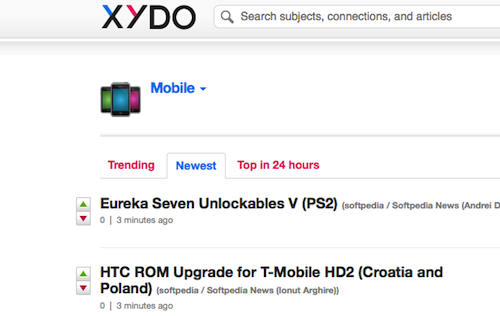
To help with my remote coverage, which involves monitoring tweets, decrypting media releases, and studying the keynote videos, I decided to take another look at Xydo. It’s the crowd-based recommendation service I wrote about a few months ago. Plus I’ve been informed it’s been re-designed.

As with other sites in this genre, the crowd votes on content, which is pulled in from a number of different sources and categorized into various topic areas.

Topics encompass this whole wide world—pasta and grains, business news, mobile, movies, and on and on

So I entered “mobile world congress” into Xydo’s global search box.Continue reading

Deep Packet Inspection and Revolution

One of the corporate blogs I review on occasion is Cisco’s The Platform.

In a post published on Sunday, and in time for the press deluge coming out of the Mobile World Congress in Barcelona, Cisco pre-announced its new “framework” for mobile operators, called MOVE or Monetization, Optimization, and Videoscape Experience.

Run of the mill marketing prose. My attention was instead engaged by a product referred to in some of the MOVE marketing material, Cisco’s ASR  5000  “gateway mutlti-media platform.”

The impressively engineered ASR 5000 could probably stop a Facebook inspired revolution at the speed of a mouse click. And as a propaganda minister, you wouldn’t have to take your country’s Internet off the grid to accomplish this.Continue reading

New York Tech Meetup 2/8/11: Hackopolis

Last night at New York Tech Meetup there were clear signs that the local tech ecosystem is growing and evolving.

First, the NYTM organization itself is looking for a managing director to essentially oversee the affairs of the organization—events, outreach, special programs, marketing.  The jobs starts at $65k per year (see below).

The second data point was NYTM board member, Evan Korth, announcing that hackNY.org, which he helped co-found, is doubling the size of its summer intern program. Last year, hackNY, placed 12 students in NYC startups, including etsy, 10gen, and others. Note to startups: you  have till February 18 to submit an application for interns.

The third data point was that the demos last night were really good.Continue reading

FCC to Launch New Rules on USF

FCC Chairman Genachowski has set a vote tomorrow for a  Notice of Proposed Rule Making on Universal Service Fund and Intercarrier Compensation reform.

Some of the ideas Mr. G sketched out in a speech today, in which he called the ICC System “flawed” and “unstable” and the USF “plagued with inefficiencies”,  had already been outlined in the FCC’s National Broadband Plan.

The most striking proposal in the speech, delivered at The Information Technology and Innovation Foundation, was a plan to “phase down intercarrier payments.”

As I’ve written about before (see the “Shoot the Laywers” post), the ICC rewards local carriers, mostly rural, with high per minute payments for calls terminated on their switches.  These access fees are split with services that have set up intimate talk —read porn—conference bridges in what is referred to as “traffic pumping.”

Continue reading

ITExpo Regulatory 2.0: Shoot All the Lawyers

There was one part of ITExpo I was able to attend remotely.

The Regulatory 2.0 sub-conference at ITExpo is an under-appreciated gathering of lawyers, FCC observers, engineers, and legally-savvy telecom entrepreneurs, who all had definite viewpoints on net neutrality and other regulatory matters.

Thank you Rich Tehrani and TMC (the organizers of ITExpo) for live-streaming the panel discussions of this “co-located” event to the millions of policy wonks who care about section 706 authority. 😉

Not knowing what to expect, I tuned into the “If Engineers Wrote the Rules” chat. It was less than an hour, but I thought someone on this panel would suggest how the telecom rules should be organized in a more logical, Spock-like way.

Other than wanting to remove lawyers with great prejudice from the FCC, the only policy recommendation offered was less rules.

While I didn’t agree with many statements coming from the panel, which included Richard Shockey, co-author of the SIP RFC and now board chairman of the SIP Fourm, it was a stimulating discussion and I learned a few things.Continue reading

ITExpo Stream of Consciousness

Axel Rouvin/Wikipedia

Fax over IP …  Aculab cloud … AT&T mobile hotpot …  Kevin Martin recalls threat to change FCC vote …  Sprint’s WiMAX …  Startup Camp this evening … the end of POTS in 10 years … open source UC with Asterix and Elastix … Allworx gigabit Ethernet phone …  SIP trunking …  hosted PBX … cloud-based media processing …

That’s as much as I’ve picked up reading tweets, watching  short videos, and dipping into a few blog posts. I’ve not been to a telecom-focused trade show event recently. So it’s reassuring and a sign of industry health (except for, er, fax over IP) that many of the same players, products, and big themes that ruled a few years ago still are making waves at ITExpo 2011.

What’s really new is the rise of powerful data centers —the cloud—and the virtualization technology that makes it all possible.

I was therefore most intrigued by the buzz around the keynote speech on cloud-based VoIP delivered by Aculab’s Alan Pound.

Continue reading

The Great Printer Die-off

When future paleontologists examine the fossilized remains of today’s corporate printers, they’ll re-use dinosaur die-off theory to explain the mystery of these inkjet beasts: “A series of environmental changes and perhaps a disruptive technology or two set them on the path to extinction.”

One of those disruptive events has only recently meteored through the tech sky. Anyone passing an empty Barnes and Noble— say for example, the Brontosaurus-size flagship near NYC’s Lincoln Center—knows that ebook readers have smashed the book industry into bits. Borders ain’t doing so well either.

But what’s happening in the consumer world is also recurring more quietly in the closed corporate ecosystem.

Instead of feeding their printers with reports, PowerPoints, and emails, enterprise workers have been using their laptops and now their mobile gadgets as electronic readers.

When will printers disappear from the enterprise scene altogether?Continue reading

ITExpo East 2011

Babak Gholizadeh/Grand Bazaar, Istanbul

No, I’m not attending.

But I am soaking up this VoIP trade show’s ambiance remotely by dipping into tweets, blog posts, and video snippets.

At past VoIP conferences—it’s frankly been a few years since I walked those aisles—there was a divide between vendors selling their enterprises wares and service providers with their service offerings.

ITExpo is instead a mashup of companies from both sides of the wire.

Of course, the cloud has much to do with this blurring of the lines. Continue reading

Zoom Telephonics Tests Open Internet

Back in November 2010, Zoom Telephonics, makers of cable modems, filed a complaint with the FCC against Comcast.

The modem manufacturer cited anti-competitive practices in Comcast’s new Physical and Environment (P&E) acceptance testing of their modems. According to Zoom’s filing, “Comcast’s P&E testing regime contains a host of unreasonable, irrelevant, time-consuming, and costly requirements.”

Current statutes in the Communications Act (Title VI, section 629) allow cable operators to restrict the use of modems to those that do not cause network harm or enable service theft.  Zoom says that its modems are being excluded based on testing criteria involving, ahem, modem weight, labeling, and packaging.

With  the approval of the FCC’s new Open Internet rules in December, Zoom seems to have a new line of attack.  Continue reading